
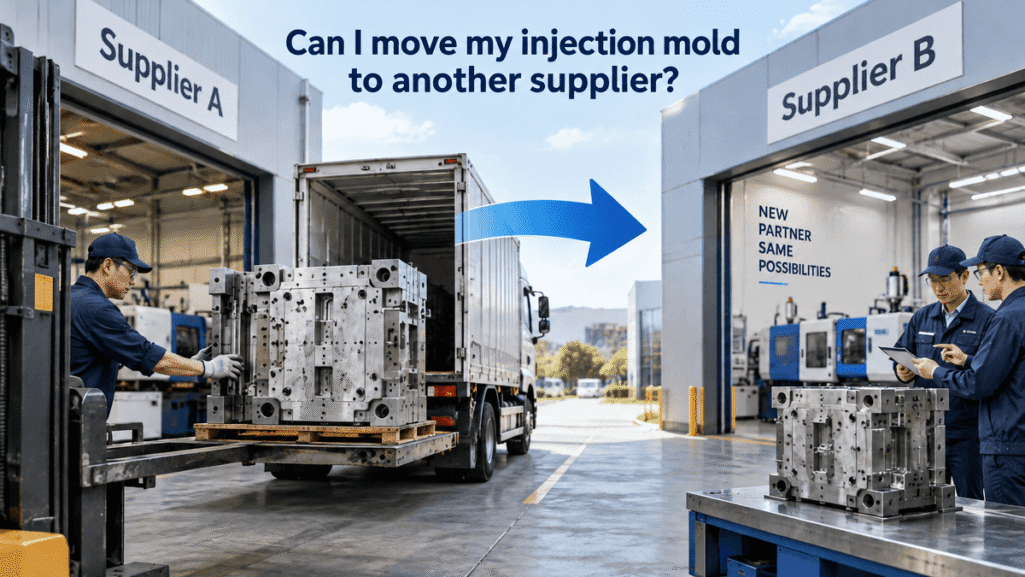
When your injection molding supplier can’t hit lead times or maintain consistent quality or keeps raising prices,transferring your mold to a new maker sounds like an appealing way to skip the cost of new tooling.Switching injection molding mold suppliers means far more than simply hauling the mold away,for you transfer a full set of already validated production conditions.
4 Key Things to Check Before Transferring Your Injection Mold
Confirm Mold Ownership and Transfer Rights
Many buyers assume they own the mold after payment,but injection molding mold ownership terms vary widely under three common setups:
- Outright purchase: Full upfront tooling payment grants complete mold ownership to the buyer.
- Amortized tooling:Mold costs are built into unit pricing, with ownership transferring only after you hit the agreed order volume.
- Rental model: The molder retains mold ownership, and the buyer pays per production shot.
Locate the mold ownership clause in your contract. The mold belongs to you if the agreement assigns ownership to Party A (the buyer) and all payments are fully settled. For amortized terms or ownership transfer after a set shot count, confirm you have reached that milestone first. If the mold stays with the supplier under a per shot payment arrangement, mold transfer is not possible.
Tip:Avoid informing the supplier of your mold transfer plan before ownership and settlement status are confirmed,as early notice will weaken your negotiation leverage.Suppliers often claim lien rights,so the contract shall specify buyer ownership and prohibit mold withholding over unpaid product balances.
Obtain Technical Documents and Production Records
Beyond shipping the physical mold, mold transfer relies on supporting technical documents that directly set trial lead time and transfer risks for your new supplier.Listed below are five groups of essential technical documents,compiled from our years of field experience.
عفن دrawings:You will need complete 3D mold files and 2D shop drawings marked with ejector pin layout, water channels, vent positions and critical tolerances.
Risk:You will face delays when waterline layouts stay unknown, as cooling tuning and troubleshooting for sink marks, warpage and blockages become much harder.
Mold BOM list:List part numbers, material grades, and specs for standard components such as springs, O-rings,guide pins and guide bushings.
صب صarameter سheet:Pull the full parameter package saved from the finaltrial run.This includes melt temperature, mold temperature, injection pressure,injection speed, pack switch point and cooling time.
Risk:Without proven process sheets,the new team must run DOE tests from scratch. Trials may stretch for days or a week, generating substantial scrap.
Raw مaterial دocumentation:Gather the material datasheet, resin grade, regrind ratio, drying guidelines and supplier details..
Hot رunner & حydraulic جore صull دata:Collect hot runner wiring diagrams, complete temperature controller settings, plus working pressure and stroke values for core pull cylinders.
Risk:Teams often lose 2 to 3 extra days tuning hot runner balance when these settings go missing. Wrong cylinder parameters can mix up piping connections, mess up opening sequences and even cause mold collision.
Check New Supplier’s Machine Compatibility
When you choose a new supplier to take over your existing mold, full documentation is not enough without proper equipment matching, with key checkpoints listed in the table below.
|
Matching Dimension |
Check Items |
Consequences of Mismatch |
|
Clamping Tonnage |
Verify that the required clamping force falls within the machine’s capacity, with a 1.2x safety factor generally recommended.
|
Insufficient tonnage causes flash or difficult mold opening, while overly large tonnage wastes energy.
|
|
Interface Size |
Check locating ring diameter, sprue bushing radius and ejector hole spacing |
The mold cannot be mounted and rework such as replacing the locating ring becomes necessary |
|
Mold Dimension |
Verify mold length, width and height against tie bar clearance and allowable mold thickness range |
The mold will not fit the machine,resulting in wasted shipping and handling |
|
Auxiliary Equipment |
Check specs and capacity of mold temperature controllers, chillers and hot runner controllers |
Poor temperature control, with inconsistent part quality |
Even with matching specs on paper,watch these practical details:
- Confirm dedicated machine reservation,not just verbal availability for trial
- Check hot runner and hydraulic core pull connections for nonstandard interfaces
- Verify crane capacity and workshop space for safe mold lifting
- Request written machine specs instead of verbal confirmation
Assess your injection molding mold for real working condition
Inspect your mold before transfer so hidden defects are not carried over to the new supplier.For a more detailed reference, see Entec Polymers’ preventive maintenance guidelines,which cover key mold inspection and maintenance procedures.
- Core and cavity wear:Surface scratches, corrosion and worn areas can alter part look and dimensions, so watch closely for these signs.
- Parting line condition:Keep an eye out for crush damage, collapsed edges, leftover flash and compromised sealing.
- Ejector pins:Scoring, uneven wear, sticking issues or mismatched pin lengths are all red flags here.
- Cooling channels:A water flow test works best to catch blockages, scale buildup and leaks you cannot see visually.
- Slides and lifters:Make sure these components move freely, with no odd gaps and reliable return action.
- Mold maintenance history:Past repair logs tell you which issues have popped up on this mold before.
نصائح: Run water flow checks and manually cycle slides and lifters
How to Transfer an بلاستيك Injection Mold to a New Supplier
Blow is a 6 steps checklist to help you organize handover and decide whether to build safety stock.
- Select and Evaluate the New Supplier
- Confirm Mold Release and Ownership
- Prepare Technical Documents
- Inspect,Packand Ship the Mold
- Install the Mold and Conduct Trial Molding
- Validate Parts Before Mass Production
نصائح: Align with both suppliers for an overlapping production window and arrange safety stock as needed to avoid supply gaps during mold transfer.
3 Common Misconceptions About صlastic أناnjection molding
If the مقديم وorks, the parts وill be exactly the سame
You should not expect identical parts just because the mold is in good condition, since machine, process and material factors also shape your injection molding moldoutcomes.
Getting the اriginal سupplier’s parameters iس enough
You cannot treat the original supplier parameters as a ready to use standard, because machine and cooling differences require tuning for injection molding mold
Let’s مove the مقديم First and Figure it اut later
You should complete checks on mold condition, equipment compatibility and documentation upfront instead of troubleshooting after mold shipment.
How Much Does injection molding mold
Cost?
|
Cost Item |
Description |
Cost Drivers |
|
Mold Removal and Packaging |
Disassembly, cleaning, rust prevention, and protective packaging |
Mold size, weight, hot runner or hydraulic cylinder systems |
|
Transportation |
Freight, customs clearance (for cross-border shipments), and cargo insurance |
Shipping distance, weight, transport method, and insurance coverage |
|
Mold Inspection and Repair |
Water channel testing, polishing, and replacement of ejector pins or seals |
Mold condition, wear, and required repairs |
|
Trial Molding and Validation |
Machine setup, sample production, dimensional inspection, and fit checks |
Number of trial runs and third-party testing requirements |
|
Process Replication |
Machine adjustment, parameter matching, and Design of Experiments (DOE) |
Part tolerance requirements and availability of original process records |
|
Administrative Coordination |
Document preparation, sample shipping, and communication between suppliers |
Project complexity and cross-border coordination |
As an extra note: if you work with suppliers located in different countries for plastic injection molding mold transfer, you can start with video checks to assess mold condition. You may then arrange your new molder to inspect the tool at the original factory. You can reach out to Grandshine for these on site inspection services. Our team has rich experience with injection molds to back you up
FAQs
How long does a injection molding mold transfer take?
A simple injection molding mold often takes 2–4 weeks, and complex molds fitted with hot runners or needing repairs can take 6–8 weeks or longer.
Who pays for injection molding mold transfer costs?
You and your suppliers negotiate cost responsibility. In most cases, you cover inspection, shipping, repair and trial fees for injection molding mold mold transfer.
Can I move a injection molding mold if I haven’t paid the full tooling cost?
Ownership follows your signed contract,and the supplier may retain the mold until full payment,so review your agreement before you plan your injection molding mold
mold transfer.
خاتمة
If you have further questions about switching injection molding suppliers or managing mold transfer risks, feel free to reach out to الحفيد.We are ready to offer support and guidance for yourinjection molding moldprojects.
المنشورات ذات الصلة
ضمان الجودة وضبط الجودة | التعريف - الفروق - الأساليب - العملية
ما هو جزء الحقن 1
تساعدك بعض النصائح على فهم آلات القولبة بالحقن الكهربائية