
Drop tests serve as a critical step to evaluate a product’s durability and structural reliability. They simulate accidental impacts from daily use, handling and shipping, checking for cracked or deformed housings and impact damage to internal components.This test method defined by ASTM D5276, helping reveal hidden structural weaknesses through drop tests for consumer electronics, automotive parts and industrial equipment.There are obvious differences in the impact resistance performance of different engineering plastics. Next, we will compare the performance and applicable scenarios of five commonly used materials: PC, PC/ABS, nylon, PA612+30% CF and PBT+20% GF.
Impact Resistant PC Material Drop Tests
Advantages
The PC delivers excellent impact resistance high toughness and low notch sensitivity. Its Charpy notched impact strength hits 60–85 kJ/m² so it avoids brittle fracture during drop tests and works well for transparent parts with stable dimensions.Consumer electronics carry a standard 1.0–1.5 m drop height which PC substrates generally meet.Tests hit surfaces edges and corners sequentially with surface drops and flat edge impacts granting PC greater tolerance against damage.
TIPS: Notched impact strength (Charpy) measures energy absorbed by a standard notched specimen under pendulum impact.
Disadvantages
While the material exhibits decent notched toughness, sharp stress concentrating notches significantly diminish its impact resistance. It reacts to stress concentrations with sharp corners and thin walls vulnerable to stress cracking.Its chemical resistance is moderate, as contact with certain solvents can induce cracking. Furthermore, its rigidity decreases under high-temperature conditions.It reacts to stress concentrations with sharp corners and thin walls vulnerable to stress cracking.
For example:in the case of headphone housings, a 1.8-meter corner drop can easily cause the material to crack, starting from the sharp edges or corners.
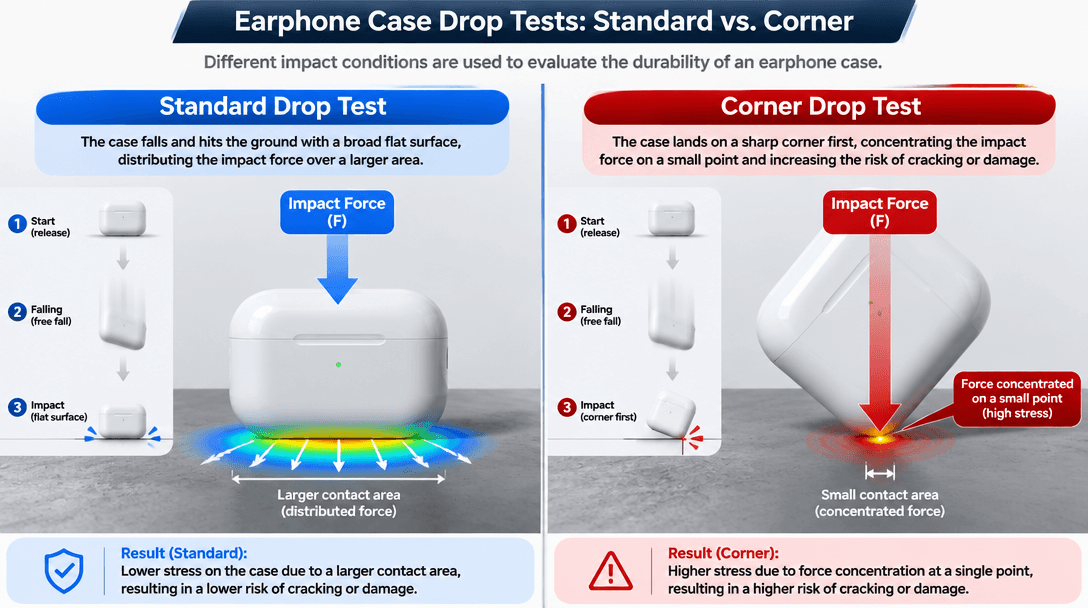
Design Tip: You should adopt generous fillet radii in structural design to avoid sharp V-shaped notches while focusing drop-test validation on corner impacts, snap-fits and thi -walled sections.Polycarbonate (PC) alone cannot deliver reliable performance for products that need to survive drops from 1.8 meters or higher, most notably corner drop impacts, so structural reinforcement becomes necessary.For example, thicken the radii at the product’s four corners and add reinforcing ribs to help dissipate the impact force during a corner drop.
Impact Resistant PC/ABS 材料 Drop Tests
Advantages
This material features solid impact performance, balanced toughness and moderate notch sensitivity, achieving a Charpy notched impact strength of 25–45 kJ/m².It has superior melt flow compared to neat PC, which simplifies molding for complex housings and yields lower internal stress.
TIPS: Molded in stress may cause spontaneous cracking under no external load. Controlling residual stress effectively lowers this cracking risk.
It typically withstands standard consumer electronics drop tests from heights of 1.0–1.5 m.The material performs steadily across face, edge and corner impacts,especially under face and shallow-edge drop conditions. Earphone housing corners and edges are more likely to suffer direct fracture under 1.8 m corner drop loading than identical parts manufactured from polycarbonate (PC).
For example: Earphone housing corners and edges are more likely to suffer direct fracture under 1.8 m corner drop loading than identical parts manufactured from polycarbonate (PC).
Disadvantages
Peak impact performance lags behind neat PC with corner drop remaining a high risk scenario. Notched features like edges and snap-fit roots fracture more readily at drop heights ≥1.8 m or under repeated cyclic drop tests. The alloy exhibits lower heat deflection temperature and inferior solvent resistance compared to PC.
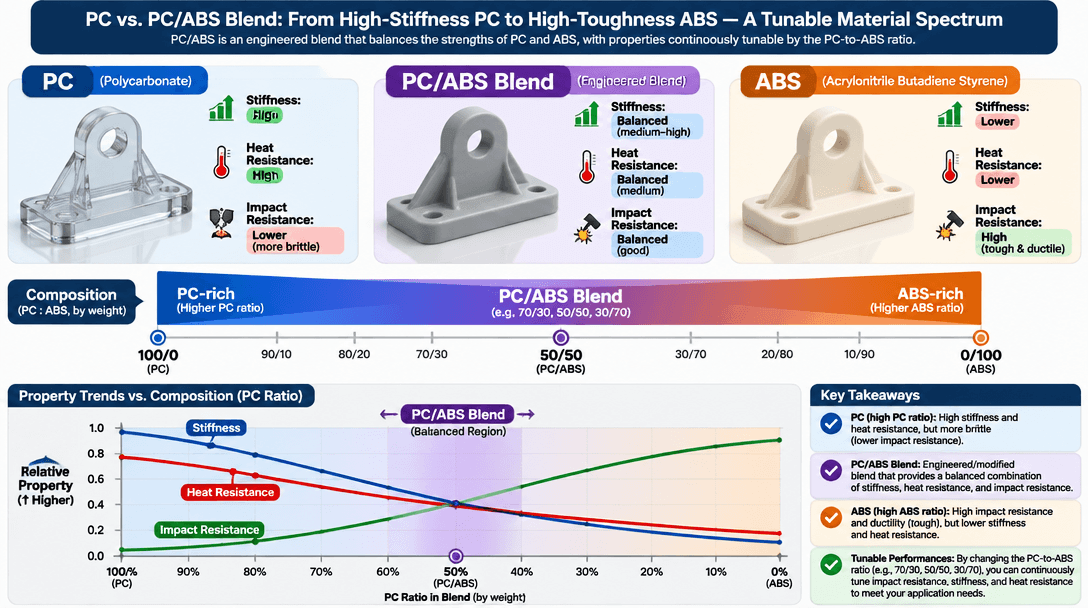
Tips: The ABS fraction in PC/ABS alloy directly controls impact behaviour. Higher ABS content improves flow ability at the cost of reduced impact strength. For corner drop validation, use larger fillets or select grades with higher PC loading to gain extra toughness.
のために Example: For identical earphone enclosure designs, PC/ABS grades with higher PC content deliver better corner drop results.Wall thickness can also be raised from 1 mm to 2–3 mm as an alternative, and グランシャイン 1201 high performance PC/ABS serves well for this application.
Impact Resistant Nylon (PA6 / PA66) 材料 Drop Tests
Advantages
This material provides excellent rigidity, wear resistance and chemical resistance while showing comparatively high notch sensitivity.Recording 6–12 kJ/m² for Charpy notched impact strength in dry condition, this material gains greatly improved toughness up to 25–40 kJ/m² after moisture uptake, since absorbed water molecules act as a plasticizer to deliver better performance in drop tests at the cost of dimensional expansion.The material demonstrates superior toughness, enabling it to pass standard 1.0–1.5 m flat-drop tests for consumer electronics with stable performance under uniform impact loads. It also suits industrial components such as automation conveyor gears and guide bushings, meeting drop test requirements at 0.8–1.2 m for on site handling and shipment
Examples: Conveyor spur gears, guide bushings-components hold up against fracture during 0.8–1.2 m flat-drop tests once the material has reached an equilibrium moisture content, yet the same parts readily crack under identical drop conditions in a dry state.
ヒント: Water molecules absorbed by nylon act as a plasticizer to improve toughness for drop tests while inducing dimensional expansion
Disadvantages
Showing notable brittleness when dry, the material faces high risk in corner drop tests, where stress concentration zones like sharp edges and snap fit roots readily crack under drop heights ≥1.5 m or repeated drop cycles.
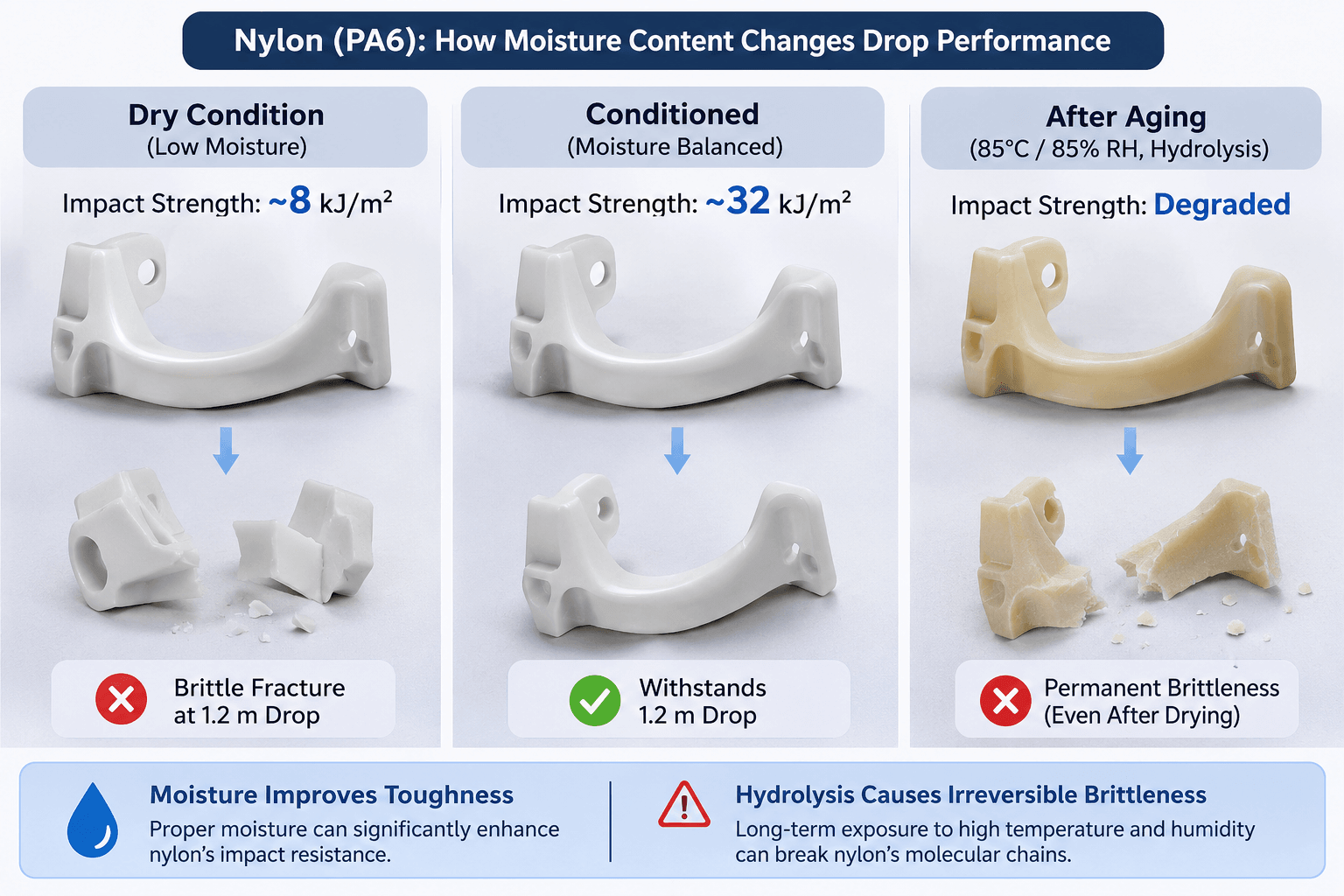
Tips:Since moisture content dominates nylon’s impact performance, generous fillets mitigate notch stress on dry components while visual appearance alone is insufficient for inspection.Drop test samples need conditioning at 23°C / 50%RH to reach moisture equilibrium before validation, as results from dry specimens do not reflect real world part performance. Toughened grades are an alternative choice for consistent drop resistance.
Example:While conditioned identical PA6 wearable brackets hit 32 kJ/m² and pass the 1.2 m corner drop test, the same parts in dry state deliver roughly 8 kJ/m² and fail this corner impact test.Parts aged at 85°C/85%RH suffer hydrolysis and permanent brittleness that cannot be restored by re drying
Impact Resistant PA612 + 30% Carbon Fiber (CF) 材料 Drop Tests
Advantages
This material delivers outstanding rigidity, dimensional stability and creep resistance with high notch sensitivity. Its Charpy notched impact strength ranges from 7–14 kJ/m². Lighter and more thermally conductive than glass filled nylon, PA612+30%CF absorbs far less moisture, so moisture content barely changes its performance in drop tests. It can pass standard 1.0–1.5 m consumer electronics drop tests and performs reliably under evenly loaded face drops.It also suits drone structural components such as frame brackets and landing gear, and can pass drop tests above 3 m with stable performance under controlled face impacts.(The difference in drop test heights between consumer electronics and drones stems from separate industry standards.)
ヒント:Carbon fiber boosts modulus and creep resistance but fails to absorb impact energy, so notch stress from drop tests can tear fiber-resin bonds and speed crack propagation to raise notch brittleness.
Disadvantages
Inherently stiff and brittle, this material carries high risks under corner impact loading. Vulnerable zones such as sharp corners and snap-fit roots tend to crack when exposed to drop tests from heights ≥1.5 m or repeated cyclic drop loading.While carbon fiber elevates the material’s modulus, it barely contributes to impact energy absorption and leaves minimal toughness margin for drop tests.
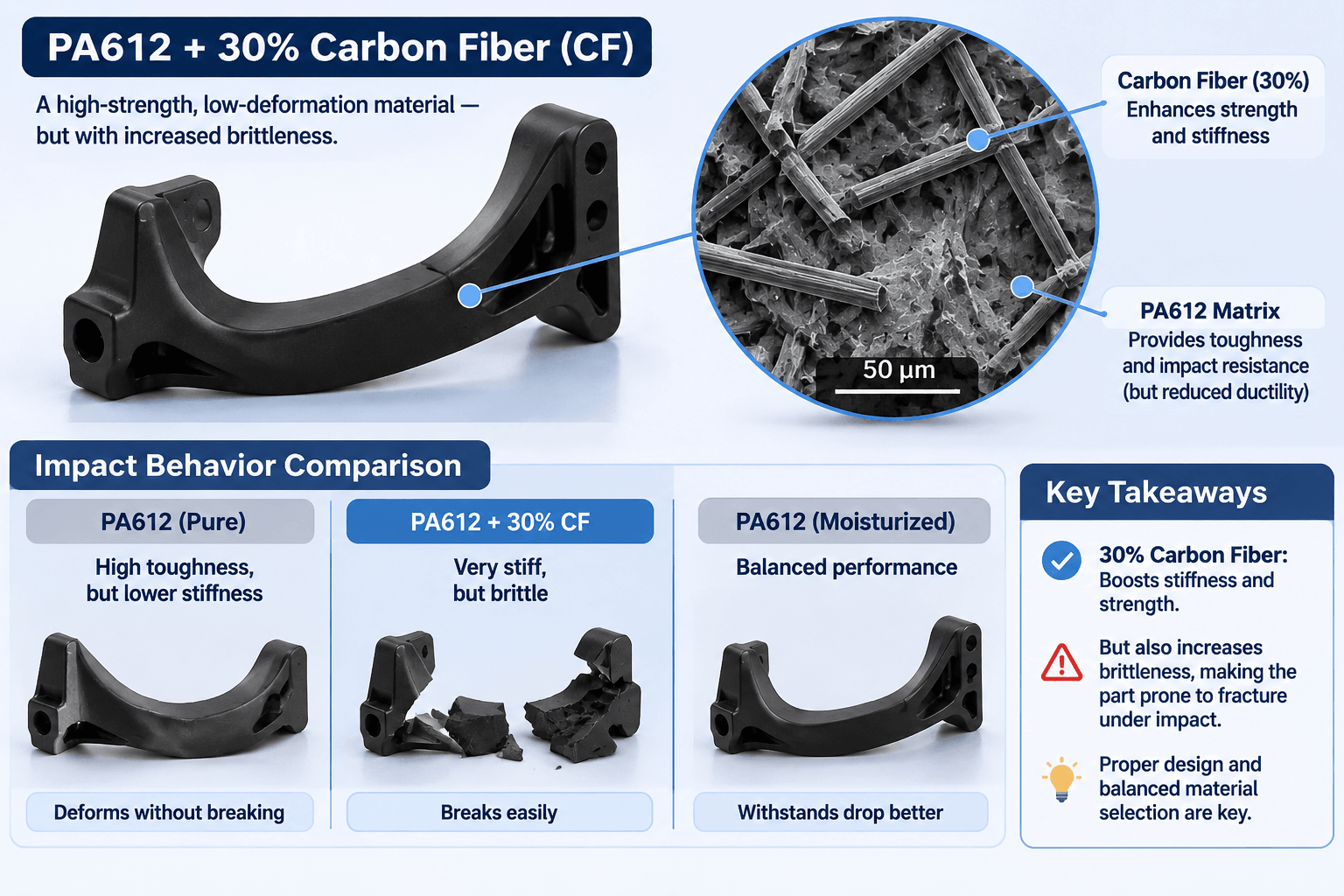
Tips : Drop test performance of this material sees minimal influence from moisture content.Carbon fiber dispersion, notch geometry and molded in residual stress serve as the primary controlling factors.
Impact Resistant PBT + 20% GF 材料 Drop Tests
Advantages
With Charpy notched impact strength of 5–9 kJ/m², this material offers outstanding rigidity, dimensional stability and chemical resistance, yet high notch sensitivity creates fracture risks during drop tests.Featuring very low saturated moisture absorption and free from the moisture driven toughness change and dimensional swelling seen in nylon, this material delivers consistent results and passes standard 1.0–1.5 m face drop tests under evenly distributed impact loads.It features stable electrical insulation and non-conductive characteristics. Molded parts can be plated or finished with conductive coatings for electromagnetic shielding, offering strong suitability for EMC design and making them well suited for electrical equipment housings.
ヒント:PBT, a low moisture polyester, shows little change in dimensions and drop tests performance with humidity. Glass fiber improves rigidity at lower cost than carbon fiber but increases notch brittleness by absorbing almost no impact energy.
Disadvantages
Stiff and brittle by nature, this material carries high failure risk in corner drop tests. Stress concentrated at sharp features like snap-fit roots tends to trigger cracking under drop heights ≥1.5 m or repeated drop cycles.Its toughness falls further in cold conditions, bringing a higher chance of brittle fracture
Example:Brackets made of PBT+20GF fracture more easily than PC/ABS counterparts in 1.2 m corner drop tests.
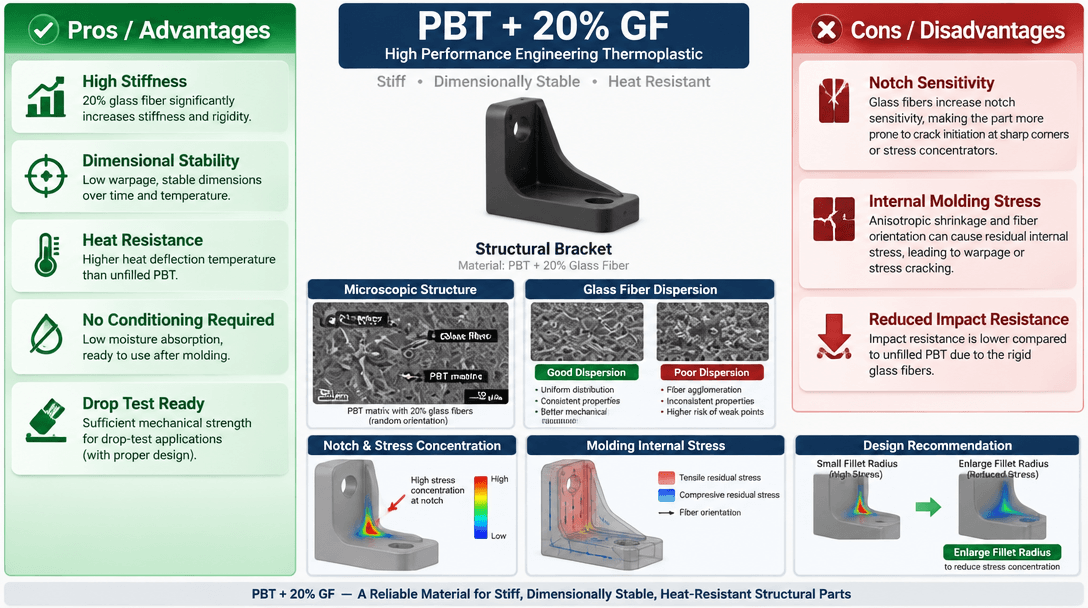
ヒント: Glass fiber dispersion, notch geometry and molded in residual stress serve as the primary controlling factors while moisture exerts little influence on material performance in drop tests.Incoming materials can be sampled directly for drop testing without the need for preconditioning (moisture adjustment). During the design phase, incorporate larger radii at corners to reduce stress concentration at notches.
Example: identical PBT+20GF circuit board brackets deliver nearly the same results in corner drop tests whether stored under dry or standard ambient humidity.
Key Factors for Plastic Drop Test Performance
We have prepared a summary table to help you clearly understand the drop test performance and influencing factors of different materials test performance and influencing factors of different material
|
Key Factors |
PC |
PC/ABS |
Nylon (PA) |
PA612+30%CF |
|
Impact Toughness |
高い |
高い |
Good |
Reduced by CF reinforcement |
|
Stiffness |
Moderate |
Moderate |
Moderate |
Very High |
|
Brittleness Risk |
Low |
Low Moderate |
Low Moderate |
高い |
|
Crack Sensitivity |
Low |
Moderate |
Moderate |
高い |
|
Low-Temp Impact Resistance |
Generally Good |
Generally Good |
Grade dependent |
Grade dependent |
|
Moisture Sensitivity |
Low |
Low |
高い |
高い |
|
Drop Test Consideration |
Excellent energy absorption |
Balanced toughness and rigidity |
Toughness changes with moisture content |
High stiffness but risk of brittle fracture |
Note: High stiffness does not equal shatterproof performance.Actual drop test performance is governed by factors including material grades,fiber orientation,moisture content, part geometry,wall thickness,temperature and test conditions.
Which Plastic Is Best for Your Product’s Drop Tests Requirements?
We’ve prepared this checklist to help you select the right plastic grade that meets your project requirements
- Clarify drop test pass standards:Confirm whether the part must survive face drops, corner dropsor repeated impact cycles.Then set acceptable cracking risks for snap fits and sharp corners.
- Evaluate your end-use environment:Check operating temperature, humidity, chemical exposure and longterm loading as these conditions will alter the material’s real toughness and drop performance.
Confirm prototype and production lead time:Factor in extra time for conditioning moisture sensitive nylons, mold adjustments for filled materials and lead time for prototype validation before formal drop tests.
結論
Every drop test scenario and material selection factor above shapes the final performance of your plastic component. If you have questions about material grading, impact testing or prototype validation, feel free to reach out to グランシャイン anytime


関連記事
品質保証と品質管理 | 定義・違い・方法・プロセス
射出成形とは何か - パート1
電動射出成形機を理解するのに役立つヒント