
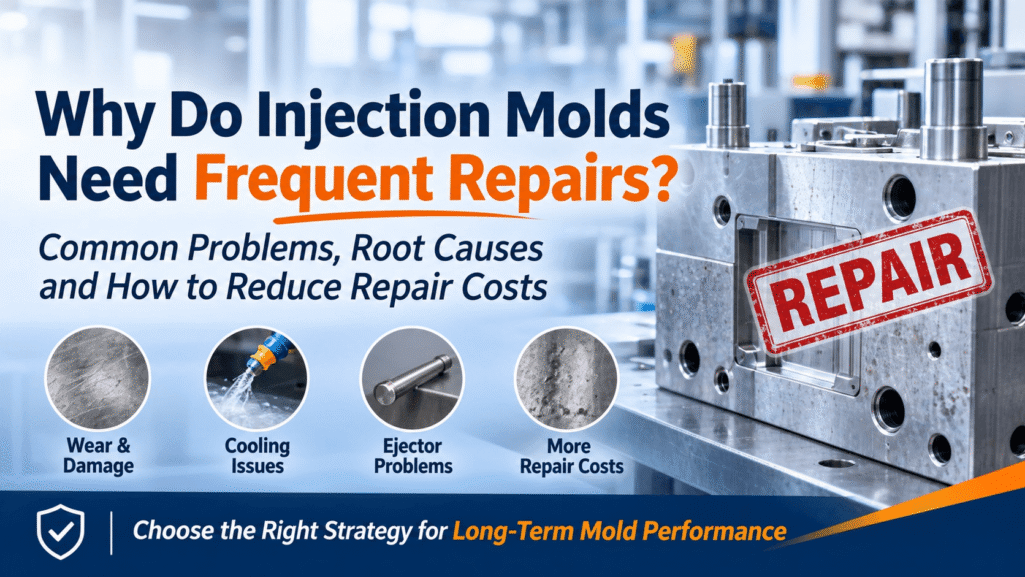
An thermoplastic injection molding mold is expected to run thousands of cycles and hold steady dimensional accuracy and part quality over time. Have you wondered why your mold fails often and needs repeated repairs long before it hits it target cycle count? This often traces back to design flaws,inconsistent build quality, poor steel selection and sloppy repair work.We’ll go over the six top causes of recurring mold repairs next.
Main Causes Of thermoplastic injection molding
Mold Failures
Poor Mold Design
- Poor cooling channel layout brings uneven cooling is the most common issue
Exemplo: Cooling channels often wind up unevenly spaced from the cavity, ribs and thick stock areas miss dedicated cooling lines, channels can run into each other, and teams frequently skip careful math to work out channel size and spacing.These issues trigger warpage sink marks,longer cycle times, internal stress and part deformation. Cooling problems sit at the root of many molding defects,and buyers bring this up often when talking with mold makers
- Insufficient venting causes gas traps and burn marks.
- Poorly designed ejector systems, slides and lifters speed up wear on moving components.
- Weak local mold structure can deform or crack under production loads.
Improper thermoplastic injection molding Parameters
- Improper thermoplastic injection molding settings create risks for your injection molding mold.Excess injection pressure raises the load placed on the tool. We have seen many mold transfer cases where previous teams cranked up pressure to cover up defects,slowly damaging cavities over time.
- Many technicians struggle to strike the right balance,as poorly set clamp force can damage the parting line.Too much force crushes sealing areas, while insufficient force triggers flash.
- Bad control over mold temperature and cooling time hurts consistent production.Some shops cut cooling time to speed up runs, delivering quick output at first yet triggering repeated warpage and dimension drift down the line.
Inadequate Mold Maintenance
- Without regular cleaning and lubrication,moving parts like slides, lifters and ejector pins tend to bind and wear.Most factories do not inspect the mold until trouble pops up.
- Cooling channels left uncleaned over time build up limescale.This narrows the channel bore and weakens cooling performance,a widespread issue for molds running mass production.
Example:Simulation work from Novoplan GmbH using Moldex3D confirms that just 1 mm of scale on channel walls can raise cavity temperature by 20 °C and sharply increase part warpage in thermoplastic moldagem por injeção.
- When maintenance and repair records are incomplete, incoming teams cannot tell which areas have been fixed.
Insufficient Technician Training and Repair Management
- Poor training affects upkeep for your injection molding mold. Maintenance technicians lack sufficient knowledge of mold structure,material properties and molding processes.They only patch visible surface damage during repairs and miss the real root cause of failures.
- Unsuitable performance metrics also create maintenance issues. Performance assessments prioritize repair speed and task volume,ignoring repair quality or repeat failure rates.
What Happens When Thermoplastic Injection Molding Mold Repairs Are Not Properly Performed?
Welding Can Cause Localized Heat Damage

Weld repairs may lead to localized thermal damage on your thermoplastic injection molding mold.
Cause:When welding, massive heat concentrates instantly on small sections of an injection molding mold,like hitting a local spot with intense flame. If welding current,filler material and heat input parameters are not properly controlled,hardness at the welded area will shift abnormally.
Consequences:
- Local softening:The affected zone loses wear resistance,prone to denting and rapid wear during production.
- Rising residual stress:Stress builds up inside the steel and releases gradually through repeated heating and cooling cycles.
- Immediate or delayed cracking:Tiny cracks are hard to spot visually at first.They spread under continuous load and can ruin the entire mold.
Buyer Considerations:Ask your supplier to create a customized welding plan matched to your exact mold steel grade such as P20,H13 or S136.And you verify requirements for preheating,gradual cooling and post weld stress relief treatment,scheduling hardness and crack inspections after welding before the mold returns to production.
Excessive Grinding Can Change Mold Dimensions
Repeated polishing can wear away fine mold features and excessive grinding quietly alters dimensions on your thermoplastic injection molding mold.Some technicians strip away excess base material to erase scratches rapidly,disrupting critical dimensions,fitting clearances and the original alignment between mold components.
Cause:
- Dimensional deviation
- Abnormal fitting clearance
- Worn or fully removed surface hardening layer
Buyer Considerations: Have your supplier remeasure key dimensions and clearances after repair while double checking for damage to nitrided, carburized or other hardened surface layers since this check often gets overlooked.
No Hardness Reinspection After Repair
Some suppliers only inspect appearance and dimensions after mold repair.They skip checks to see whether welding,grinding or other work has altered material hardness on your thermoplastic injection molding mold.
Potential consequences:
- Changed local hardness
- Reduced wear resistance
- Premature wear and recurring damage
Buyer Considerations:You recheck hardness across repaired zones impacted by welding, heat treatment or other property altering processes,matching collected test data against the original technical specs tied to the mold steel and repair workflow.
Thermoplastic Injection Molding Mold Repairs That Restore Shape but Not Function
Many technicians focus only on restoring shape and dimensions without testing how mold performs under real production conditions.
Potential consequences:
- flawed cooling
- inconsistent ejection
- inadequate venting
Buyer Considerations:You can get your supplier to run mold trials,dimension checks and functional tests after repair to confirm the mold churns out good parts consistently.
How Can Buyers Cut Long Term Repair Costs For Thermoplastic Injection Molding Molds?
Evaluate Mold Design Before Manufacturing
For cooling channels, venting layout, ejection setup and mold strength, you run a careful review to catch hidden design issues early.
Balance upfront quotes with long term durability
You check steel grade, heat treatment specs, machining standards and expected service life for your thermoplastic injection molding mold.
Evaluate your supplier’s manufacturing capability
Beyond simple documents, check out their CNC machines, heat treatment workflows, dimensional testing gear and past thermoplastic injection molding mold projects like yours.
|
Inspection Item |
Verification Requirements |
|
Hardness Testing |
Confirm the hardness of the repaired area meets material and process specifications |
|
Dimensional Inspection |
Check critical dimensions and fitting clearances |
|
Surface Inspection |
Examine polishing quality, cavity details and surface condition |
|
Functional Testing |
Verify cooling, ejection and moving systems |
|
Trial Molding |
Validate part dimensions and production stability |
Require Repair Inspection and Performance Verification
Establish Clear Maintenance and Repair Responsibilities
Lock down warranty terms, repair accountability, maintenance intervals, record requirements and rules for repeated failures in your thermoplastic injection molding mold contract, so you avoid disputes down the line.
EXAMPLE
Seller warranty scope:These fall under the suppliers responsibility,such as substandard steel,insufficient hardness from heat treatment,cooling channels blocked by machining debris,original design flaws in venting, ejection or slide mechanisms, wrong machined dimensions,and poor weld repair work.
Buyer covers these non warranty costs:You cover costs for cavity damage from foreign debris,unapproved high pressure or high speed runs, unauthorized adjustments to the mold or hot runner,missed routine maintenance,corrosion,accidental mold crashes and changes needed for product design updates all of these count as non warranty work.
Conclusão
If you are troubled by repeated mold repairs and seek reliable solutions, feel free to reach out to Grandshine for support.
Postagens relacionadas
Garantia de qualidade e controle de qualidade | Definição-Diferença-Métodos-Processo
o que é a moldagem por injeção-part1
Algumas dicas ajudam você a entender as máquinas injetoras elétricas