
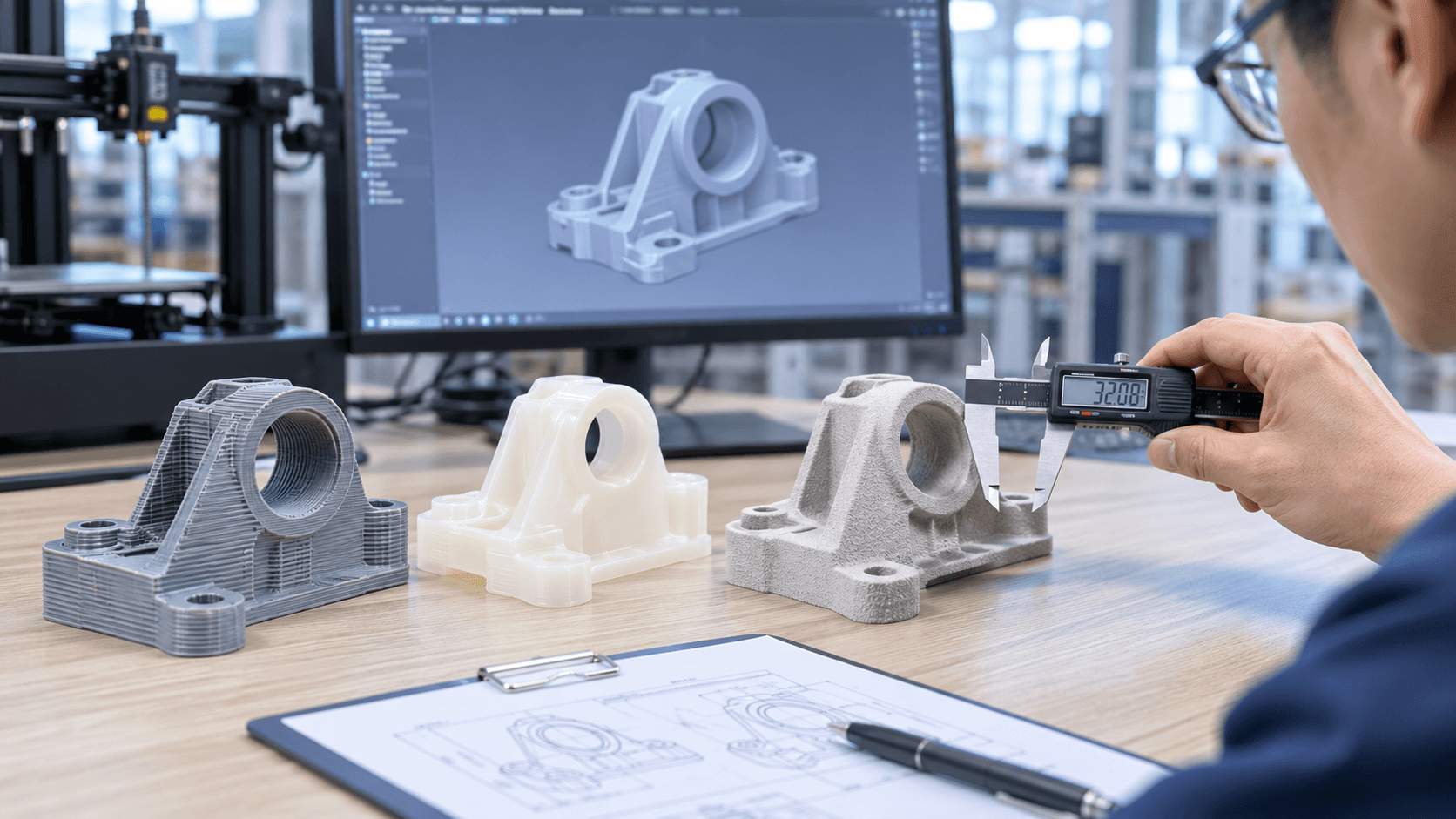
Do you often find yourself puzzled by the prototype price? Have you ever sent the same CAD file to different suppliers, only to receive vastly different quotes? You might wonder if some suppliers are overcharging you but that’s usually not the case.These quote gaps usually boil down to materials, printing methods, part shapes and finishing work. We’ll go over what pushes 3D printed prototype price up or down.It helps procurement teams read these quote gaps and choose wisely.
What Factors Affect the Price of a 3D Printed Prototype?
Sélection des matériaux
PLA: Great budget option. It turns brittle and can’t stand heat, so skip functional tests ,stick to visual demos only.It is also a cost-effective choice when keeping your prototype price low is a priority.
ABS: It costs more than PLA but delivers solid toughness, good impact strength and works really well for painting.
Nylon: Higher in cost, it offers high strength and wear resistance. It is well suited for structural components subject to stress or parts that will undergo repeated assembly and disassembly.
Photosensitive Resin: Standard ones offer solid value. Specialty versions like clear flame retardant PClike and PPlike resin cost more and render finer details.
Tips: When considering functional validation, do not blindly opt for the most expensive material. A higher price does not guarantee better performance in heat, load-bearing.
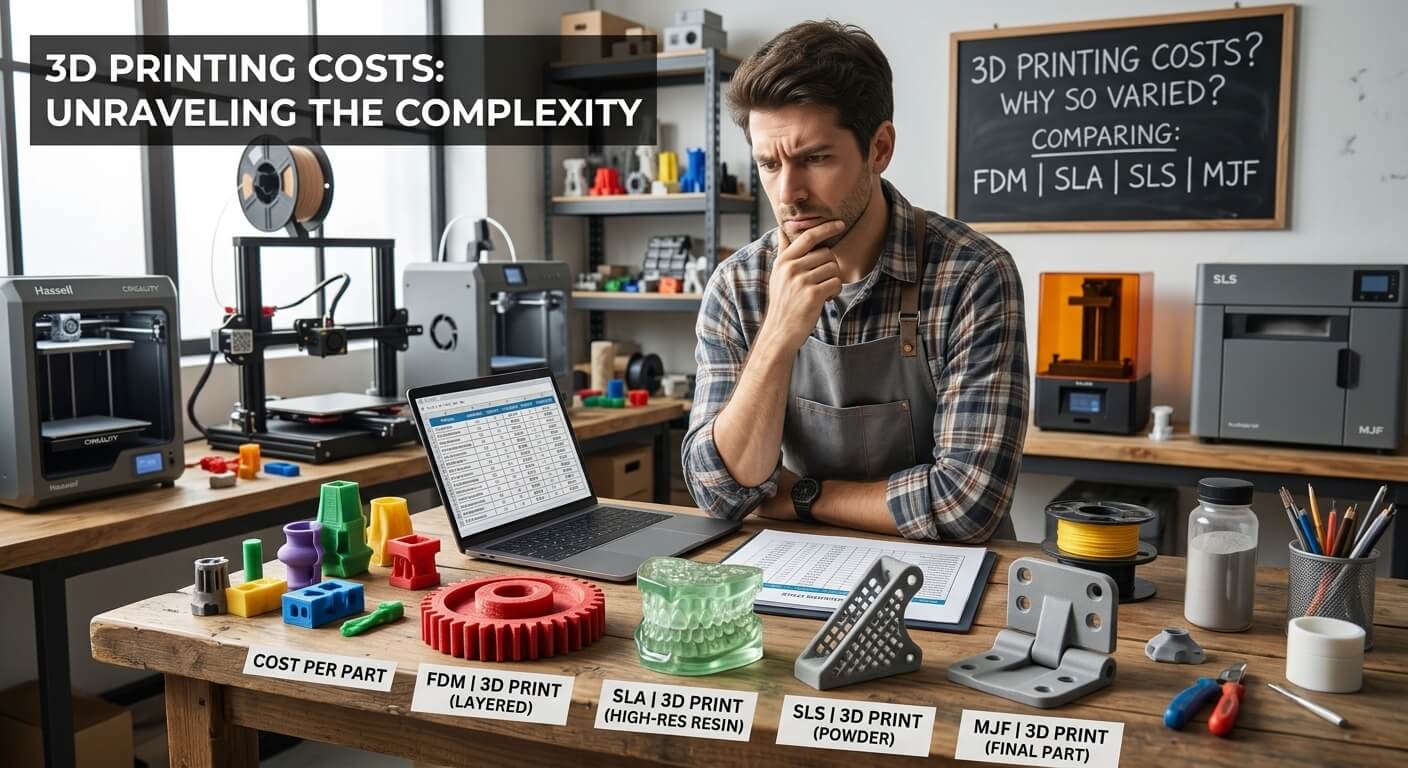
Different 3D printing processes have different equipment hourly costs, material costs, material utilization rates, and post-processing procedures, which will lead to differences in quotations. For two parts of the same size, if the selected process acceptance requirements are different, the price of the prototype may also be very different.
FDM (Fused Deposition Modeling): Filament comes cheap and its machine hourly rate sits lowest out of these processes. Supports have to come off after printing so material efficiency takes a hit. Finished parts show clear layer lines. Layer height infill part orientation and geometry complexity decide print speed and final quality.
SLA (Stereolithography): SLA costs more on material and machine hours than FDM. Parts go through support removal cleaning and UV curing which adds labor expense. It delivers smooth surfaces and sharp fine details good for appearance prototypes demo models and visual design checks.
SLS / MJF : SLS and MJF run on costly industrial powder systems, bringing steep depreciation and running expenses.They need no conventional supports unlike FDM or SLA. Leftover powder gets sieved and blended with new stock and multiple parts can pack into one build to use material efficiently.Still powder savings do not guarantee lower total cost. High hourly machine charges, cooling cycles and blasting work can drive spending up.These methods fit complex shapes, fine features and functional prototypes for strength and assembly durability tests.
Tips : 3D Priting Technology: Cost Comparison
|
Cost Factor |
FDM 3D Printing |
SLUN 3D Printing |
SLS/ MJF 3D Printing |
|
Equipment Investment |
PLA, ABS, PETG, TPU,generally lower in cost. |
Photosensitive resin, higher cost.
|
Industrial PA12 & PA powders,higher material cost. |
|
Machine Hourly Rate |
Lower, varies with print time |
Higher than standard FDM |
Higher, tied to machine utilization |
|
Material Utilization |
Supports&waste raise material use |
Parts and supports consume resin |
Unfused powder recyclable, with required fresh powder mix |
|
Printing Time |
Depends on height, layer, infill, speed |
Depends on height, layers, orientation |
Depends on height, batch count, machine efficiency |
|
Support Structures |
Overhangs usually need supports |
Supports added per geometry |
No conventional supports needed |
|
Post-Processing |
Support removal, sanding |
Clean, post-cure, de-support |
Cool, depowder, blast |
|
Labor Cost
|
Manual de-support & finishing |
Manual clean, cure & finish |
Manual depowder, retrieval & blasting |
|
Key Cost Drivers |
Print time, infill, supports |
Resin use, supports, cure & clean |
Machine rate, packing, powder refresh, post-process |
|
Typical Applications |
Low-cost concept dimension checks |
High-precision visual models |
Complex functional prototypes |
Machine hourly rate: the hourly running cost of printers, covering power, depreciation, labor and maintenance. Higher material efficiency does not always mean lower prototype price. SLS / MJF recycle powder well, yet heavy cooling and extra manual work push quotes up.
|
Machine Hourly Rates |
Specific instructions |
|
Equipment Depreciation |
Amortized equipment purchase cost over service life |
|
Maintenance |
Repairs, maintenance and spare parts replacement |
|
Electricity |
Power for machine operation |
|
Labor |
Labor for operation and production management |
|
Facility Overhead
|
Facility rent and related overheads |
|
Equipment Utilization |
Ratio of runtime to available production time |
Part Dimensions and Structural Complexity
- Larger part dimensions require more material and longer printing times.
- Thinner internal walls, more complex curved surfaces, and a greater number of internal channels increase the difficulty of the printing process.
- The specific requirements for support structures and part orientation can further increase material consumption and extend processing time.
- Parts of the same size may have different prototype prices due to differences in their structural design
Surface Finishing & Post-Processing
There is a clear difference in prototype price between the newly printed rough prototype and the sample after grinding, painting, and high gloss polishing. Different materials, different printing processes, and basic post-processing are also different: After printing SLA photosensitive resin parts, the residual glue must be cleaned first, UV secondary curing must be performed, and the support must be removed the temporary bracket used to hold the suspended position during printing must be cleaned after molding; for FDM PLA and PETG wire parts, the support must be removed first, and then polished and smoothed
This SLA resin flat housing (150×100×30 mm, 2 mm wall thickness) serves as an example:
- Basic: support removal + deburring — $10–13
- Support removal + sanding + matte painting — $16–20
- Clear resin: support removal + sanding + tint for semi-transparent effect — $18–23
- Paint plus tapping for threaded assembly holes — $22–27
Each extra operation takes extra labor time. More work pushes prototype price higher. When comparing prototype quotes, confirm what post-processing is covered.
Note: Please note that these figures are provided solely for reference and your final pricing will be subject to change based on factors including resin selection, tolerance requirements and agreed production lead time.
Order Quantity and Production Efficiency
When producing only a single prototype, all fixed setup costs such as file processing, machine configuration, and warm-up that must be absorbed by that one piece, which significantly drives up the prototype cost
What Should a 3D Printing Quote Include?
Many buyers judge a prototype quote only by the bottom line. This is a common trap. Two quotes with similar numbers can cover very different scopes of work, and your final prototype price may end up much higher than planned. A transparent quotation breaks down charges clearly.
We use our familiar SLA photopolymer resin tablet shell (150×100×30mm, wall thickness 2mm, first article sample: support removal, sanding, matte painting + FA dimensional report) for this breakdown:
|
Quote Component |
Breakdown for this FA sample |
|
Material Cost |
Photopolymer resin including support waste: approx. $6 |
|
Printing and Setup Cost |
File check, nesting, machine setup and print runtime: approx. $5.5 |
|
Post-Processing Cost |
Support removal, washing, curing, sanding and matte painting: approx. $5.5 |
| cQuality Inspection |
First article dimensional check and inspection report: approx. $1.5 |
|
Shipping and Delivery |
International courier is normally excluded. It only covers standard packing. Express freight, customs duty and local taxes are charged separately. |
|
✅ Total (EXW price) |
$18.5 |
How to Get a More Accurate Prototype Quote and Understand Your Prototype Price?
Cosmetic Requirements: You can accept minor support marks and light sanding scratches on concealed surfaces, just make sure each mark stays under 0.3 mm and does not join up with others.Visible surfaces may only have faint marks that do not spoil the overall look.Pinholes and obvious color variation are not allowed. Painted parts need color deviation kept within ΔE < 2.
Dimensional Tolerances: Non critical features allow ±0.15 mm while snap fits and mating interfaces require tighter control at ±0.08 mm. For most orders, visual inspection combined with spot checks using calipers is sufficient.CMM inspection and formal inspection reports are reserved for cases requiring exceptionally high precision.
Functional Requirements:Snap fit structures must remain secure without loosening or fracturing after at least 10 removal cycles.The assembly gaps are typically set between 0.05 mm and 0.15 mm.If heat resistance is a primary testing criterion,the target temperature and test duration must be explicitly specified.
Non Conforming Items:It should be clarified in advance whether the supplier will provide free replacements for parts that do not meet specifications.We can work out a discounted price for minor flaws that do not impact assembly. But if defects come from design changes we request, the supplier will need to issue a new quote.
Note: These figures are reference values for SLA resin prototypes. Tolerances for SLS and FDM parts are looser so confirm baseline specs with your supplier before order placement.
Conclusoion
Feel free to get in touch Grand éclat. if you have questions about prototype manufacturing, 3D printing processes or pricing. We would be happy to provide further information, answer your questions and offer a detailed, transparent quote tailored to your project needs and prototype price.


Articles Similaires
Assurance qualité et contrôle qualité | Définition-Différence-Méthodes-Processus
quel est le moulage par injection-part1
Quelques conseils vous aident à comprendre les presses à injecter électriques