
Quick Answer
Why Mold Steel Selection Matters for Production Volume
High end steel may unnecessarily raise upfront tooling costs for low volume production while lower grade steel wears quickly in high volume runs and triggers frequent maintenance, mold replacement and production downtime. Matching mold steel to the expected production quantity helps control overall costs while ensuring consistent part quality throughout the mold’s service life.
P20 vs H13 vs S136 Mold Steel Key Differences
P20 Mold Steel
P20 is a widely used pre hardened injection mold steel supplied at 28 to 32 HRC.This eliminates the separate quenching heat treatment step after machining which cuts mold lead time and removes the risk of thermal distortion.It delivers moderate wear resistance and limited corrosion resistance,supporting textured or basic polished surfaces but incapable of mirror finishes.Its superior machinability helps hold down upfront mold investment.
As specified in ASSAB’ s plastic mold steel technical documentation,P20 is targeted for low to medium production runs with non corrosive general plastics such as ABS,PP and PC/ABS blends.
A representative example:
This textured flame retardant ABS housing for new product validation targets 30,000 injection cycles.P20 delivers the required texture at lower tooling cost yet visible wear appears near the gate after roughly 28,000 cycles, marking its practical limit before scale up and preventing consistent performance through the full 30,000 shots.

P20 is not suitable for high volume mass production corrosive resins like PVC or parts requiring mirror polish.Repeated frictional wear and acidic volatiles released from decomposed plastics erode the mold surface and shorten service life.
H13 Mold Steel
H13 is a widely used hot work injection mold steel supplied in annealed soft condition and hardened to 48 to 52 HRC.It delivers outstanding thermal toughness and thermal fatigue resistance to resist chipping and cracking under repeated heating and cooling cycles.It offers good wear resistance and moderate rust protection,supports fine polishing and complex VDI textures and works well for high temperature engineering resins.
TIPS:HRC,a Rockwell hardness unit, denotes harder and more wear resistant steel at higher values alongside greater brittleness risk.

The heat treatment capability of the mold maker largely determines the H13 performance and inadequate heat treatment leads to direct production risks.Under tempering yields hard brittle steel prone to cracking or chipping in mass production while over tempering reduces hardness and speeds cavity wear when molding glass filled materials.
TIPS :Uneven heat treatment causes steel distortion, adding extra rework cost or even leading to total mold scrap.
Consistent heat treatment holds H13 within 48 to 52 HRC for balanced wear resistance and crack resistance.At the lower end near 48 HRC,it delivers better toughness for complex parts with sharp corners.At the higher end near 52 HRC, it offers stronger wear resistance for glass filled resins. Hardness outside this range brings faster wear or brittleness and it cannot reliably support medium to high volume production.
S136 Mold Steel
S136,widely used for precision injection molds,is supplied in an annealed state and requires heat treatment to reach 48 to 52 HRC.It delivers outstanding corrosion resistance and premium polishability for high gloss and mirror finishes,paired with reliable wear resistance for extended continuous production .The end use performance of S136 not only depends on the steel itself but is also closely related to the heat treatment process in the mold factory.
we will use a table and a picture to help you quickly understand how heat treatment affects the performance of S136
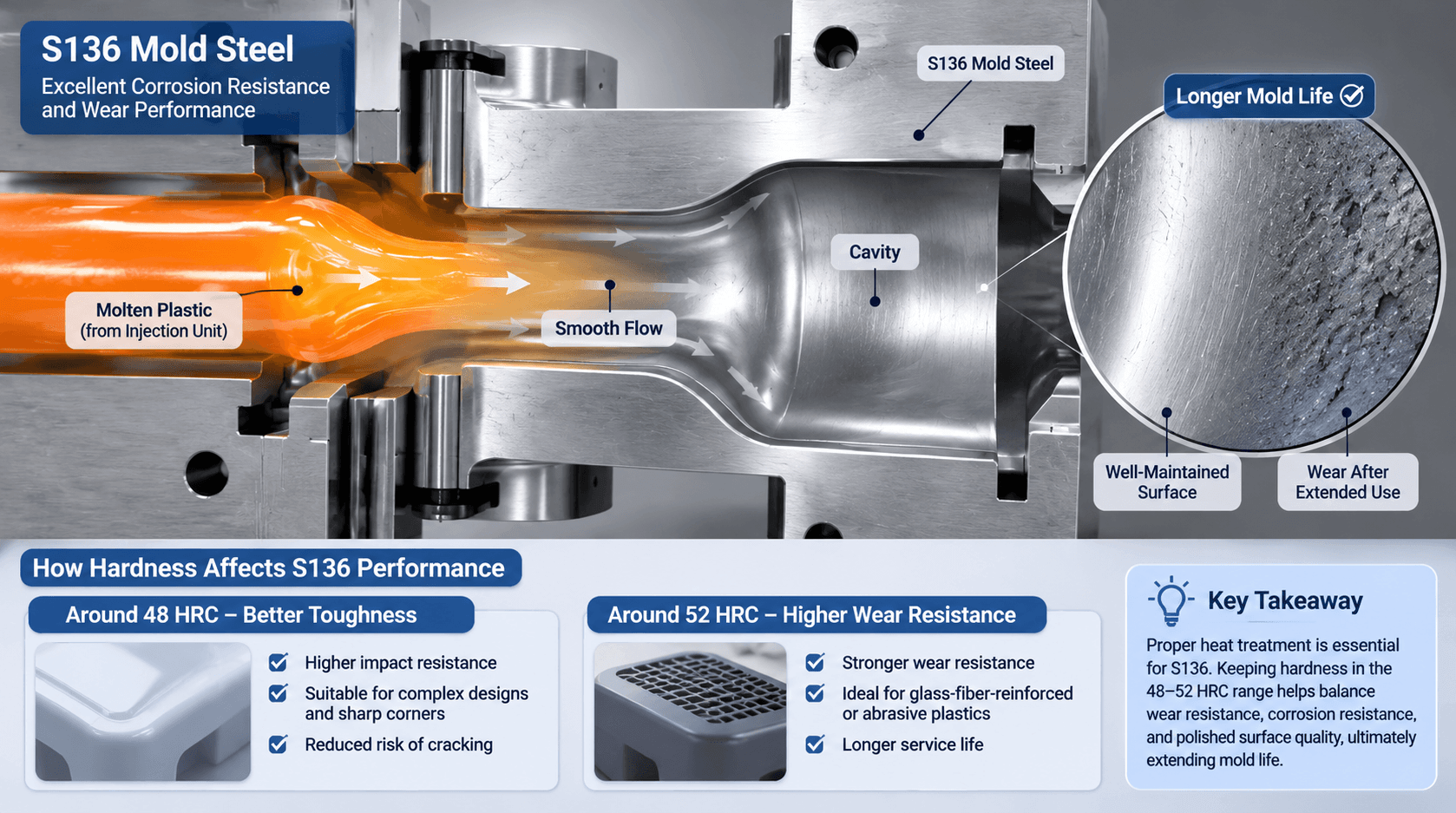
How Heat Treatment Affects S136 Mold Performance
|
Heat Treatment Condition |
Hardness Performance |
Impact on Mold Properties |
Potential Production Risks |
|
Insufficient Tempering |
Excessive hardness with reduced toughness |
Increased residual stress and lower impact resistance |
Prone to cracking under thermal cycling or continuous molding conditions |
|
Excessive Tempering |
Insufficient hardness |
Reduced wear resistance and difficulty maintaining cavity surface quality |
Surface scratches and accelerated wear during long production runs |
|
Properly Controlled Heat Treatment |
Typically 48–52 HRC |
Balances hardness, toughness, and wear resistance |
Better suited for high-volume injection molding and demanding surface finish requirements |
Note:The recommended hardness range may vary depending on the specific S136 grade, heat treatment process and application requirements.
How to Choose Mold Steel Based on Production Volume and Application Requirements
Mold Steel Selection for Low, Medium and High Volume Production
Production volume is one of the key factors in injection mold steel selection.For low volume projects,minimizing initial tooling costs is often a priority.With higher production volumes bringing greater focus on mold durability,wear resistance and long term maintenance costs.The right mold steel enables manufacturers to balance tooling investment with expected mold life and production efficiency.
Low Volume Production
For low volume production,P20 is often a cost effective choice.Its prehardened state and favourable machinability cut mold fabrication lead time and upfront tooling costs, making it suitable for projects with general purpose plastics and moderate mold life expectations.
Medium Volume Production
The selection of materials for molds used in medium volume production should be based on specific application conditions rather than determined solely by production quantity.P20,H13 and S136 each have their own suitable use cases
P20:If you use common non abrasive plastics such as ABS, PP, PE and the product does not have special corrosion resistance or high gloss surface requirements.P20 can usually meet the needs while controlling mold costs.
H13:If the plastic contains abrasive fillers such as glass fiber or the mold needs to withstand high thermal load and wear, H13 can be considered to improve the wear resistance of the mold.
S136:If processing corrosive plastics such as PVC,or meeting requirements for high transparency,mirror like polish and superior surface quality, S136 is generally the more suitable choice.
High Volume Production
For high volume production, mold durability becomes increasingly important because frequent wear or maintenance can interrupt production and increase overall costs.H13 works well for abrasive plastics like glass fiber reinforced grades and S136 fits corrosive resins or projects that need high gloss and mirror finishes.The appropriate steel should be selected based on actual operating conditions rather than production volume alone.
Why the Lowest Cost Mold Steel Is Not Always the Best Choice
When selecting mold steel, price and production volume serve as important references,yet they should not be the only deciding factors. P20 generally comes with lower upfront mold cost but that does not make it suitable for every low volume project. Similarly, H13 and S136 carry higher material and machining costs which does not restrict them exclusively to high volume production.
In fact, P20, H13 and S136 do not have rigid, fixed production volume boundaries. Even for low volume runs, H13 or S136 may be required if the part uses glass fiber reinforced plastic, or demands strong corrosion resistance and superior surface polishing. Conversely ,P20 can work after proper evaluation for high volume production with standard nonabrasive plastics and no special surface specifications.
Calculating total costs over the full production cycle matters more, as inadequate steel wear resistance causes premature mold wear, frequent repairs or early mold replacement. Steel with performance far exceeding project requirements will add unnecessary tooling expenses.
Therefore, the selection among P20, H13 and S136 requires a comprehensive review of these factors:
- Production Volume: Target shot quantity and expected mold service life
- Plastic Material:Whether glass filled or corrosive resins are used
- Surface Finish Requirements:Needs for transparency, high gloss or mirror polish
- Total Tooling Cost:Steel price, machining charges, maintenance fees and potential downtime costs
|
Comparison Criteria |
P20 |
H13 |
S136 |
|
Steel Type |
Pre-hardened plastic mold steel |
Hot-work tool steel |
Stainless plastic mold steel |
|
Hardness (Typical Range) |
Approx. 28–34 HRC |
Approx. 44–52 HRC after heat treatment |
Approx.48–52 HRC after heat treatment |
|
Machinability |
Good |
Good before heat treatment; more difficult after heat treatment |
Good before heat treatment;more difficult after heat treatment |
|
Wear Resistance |
Moderate |
Good |
Good |
|
Corrosion Resistance |
Low |
Low |
Excellent |
|
Polishability |
Good |
Good |
Excellent |
|
Typical Applications |
General plastic housings and injection molded parts |
Glass fiber reinforced plastics and applications with higher wear requirements |
Transparent plastic parts, PVC molding, high-gloss products |
Ultimately,the best mold steel is neither the cheapest nor the hardest option.It matches your part performance, production quantity and functional requirements while delivering a reasonable overall cost.
Conclusion
If you have questions about matching mold steel grades to your planned shot volume, resin type or surface requirements, feel free to reach out to Grandshine.We are ready to walk you through the trade offs and recommend a cost effective steel solution for your project.


Related Posts
Quality Assurance & Quality Control | Definition-Difference-Methods-Process
what is the injection molding-part1
Some tips help you understand electric injection molding machines