
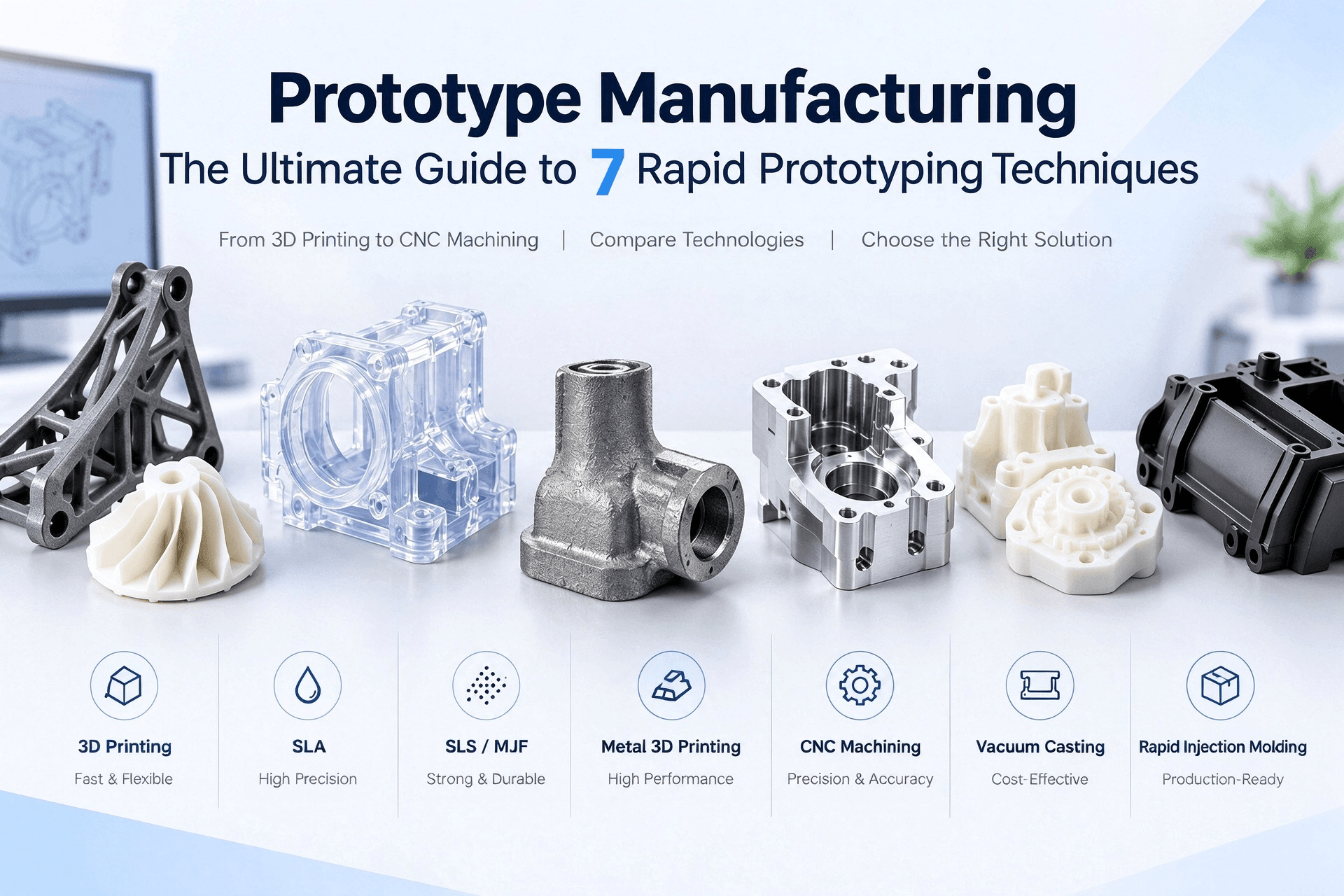
When you first run across processes for prototype manufacturing, you may wonder what they really mean, and why the word “rapid” is used. With so many options out there, new buyers and product teams often struggle to pick the right prototype manufacturing solution for their project. This article walks you through these questions.
Quick overview :What is rapid prototype manufacturing?
Simply put, rapid prototype manufacturing builds physical parts or models in a faster way. It cuts down lead time a lot, compared with conventional manufacturing methods. Its biggest benefit is letting designers, engineers and buyers test and validate designs through prototype manufacturing before you move to full mass production.
What different technologies fall under rapid prototype manufacturing?
Additive Manufacturing
With additive manufacturing, parts take shape as material is deposited layer by layer. It is one of the most common approaches within prototype manufacturing. It handles complex shapes that are hard to make with older methods. Teams can test out new design ideas fast and keep early development costs in check
FDM 3D Printing
FDM stands for fused deposition modeling. It feeds thermoplastic filament, melts it, and builds your part layer by layer.
As a buyer, you will find this process budget-friendly for fast, simple concept models. Finished parts show clear layer lines. It is not the right pick if you need intricate features or high-grade display prototypes. Typical FDM materials are PLA, ABS, PETG, PC and PP.
|
Material |
Characteristics |
|
PLA |
Easy to print, rigid, poor heat resistance |
|
ABS |
Tough, impact-resistant, better heat resistance than PLA |
|
PETG |
Balanced overall performance, transparent, moisture-resistant |
|
TPU |
Flexible elastomer with rubber-like texture |
|
PC |
High impact resistance and high temperature resistance |
|
PP |
Chemical resistant and lightweight |
Little Buyer note:PLA tends to fail functional and outdoor tests. It can crack when loaded repeatedly, and softens even at moderate heat levels. ABS, PETG and TPU are the more common picks when buyers need functional samples.
SLA 3D Printing
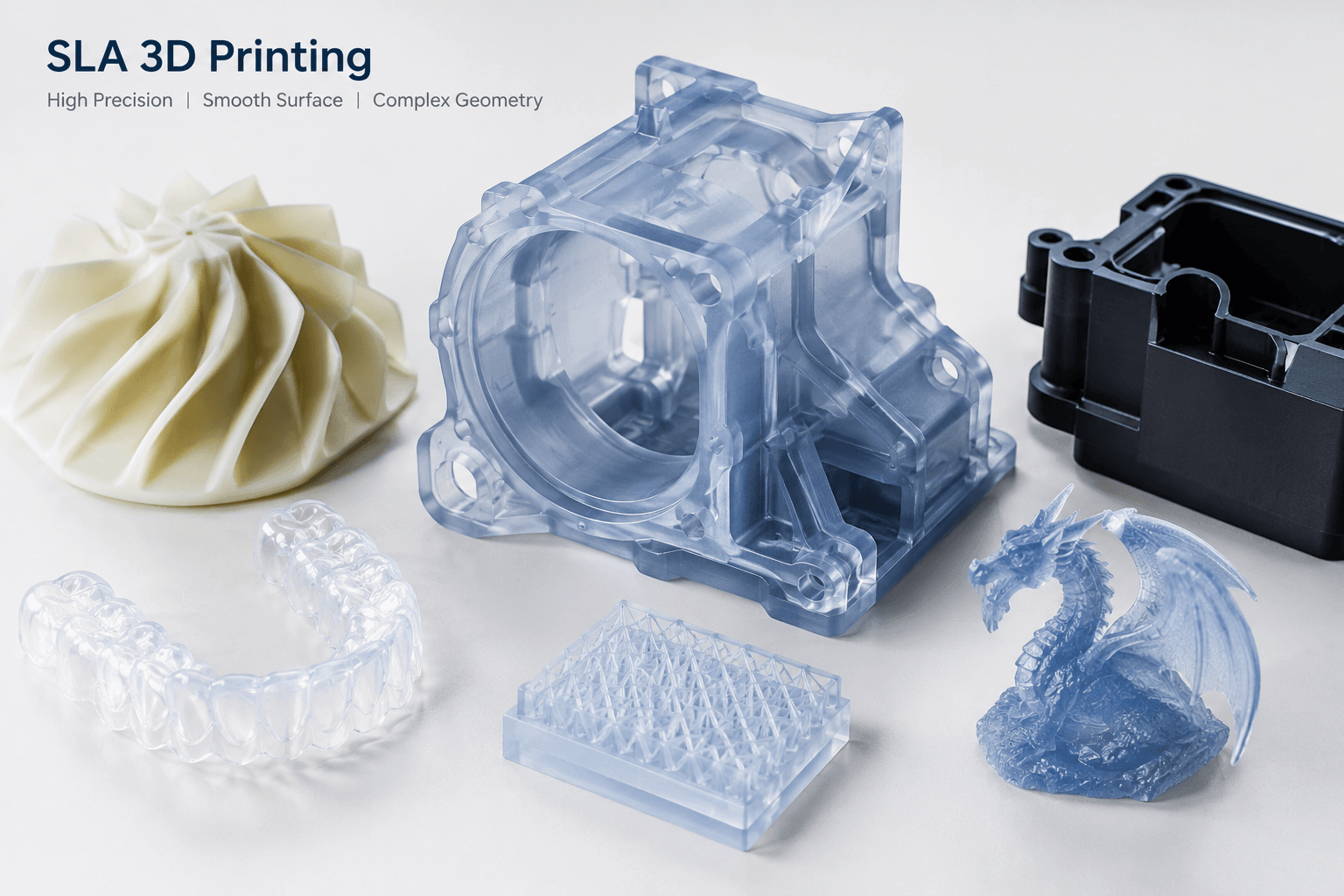
SLA, or stereolithography, uses UV light to harden liquid photoresin layer by layer. It delivers sharp details and smooth surfaces, and it is widely used within prototype manufacturing for high quality display prototypes. Still, resin has its limits. It is not strong enough, and it struggles with heat and long term environmental aging. You should judge whether it fits your use case before choosing for your prototype manufacturing project.
SLS and MJF 3D Printing
SLS stands for Selective Laser Sintering, while MJF is Multi Jet Fusion. Both use laser or thermal energy to fuse polymer powder layer by layer. They are popular picks in prototype manufacturing for plastic parts when steel tooling is not ready. They handle tricky internal structures and hold up well for functional testing. Keep in mind that surface finish, mechanical performance and unit price can vary a lot, depending on the process and part geometry of your prototype manufacturing work.
Metal 3D Printing
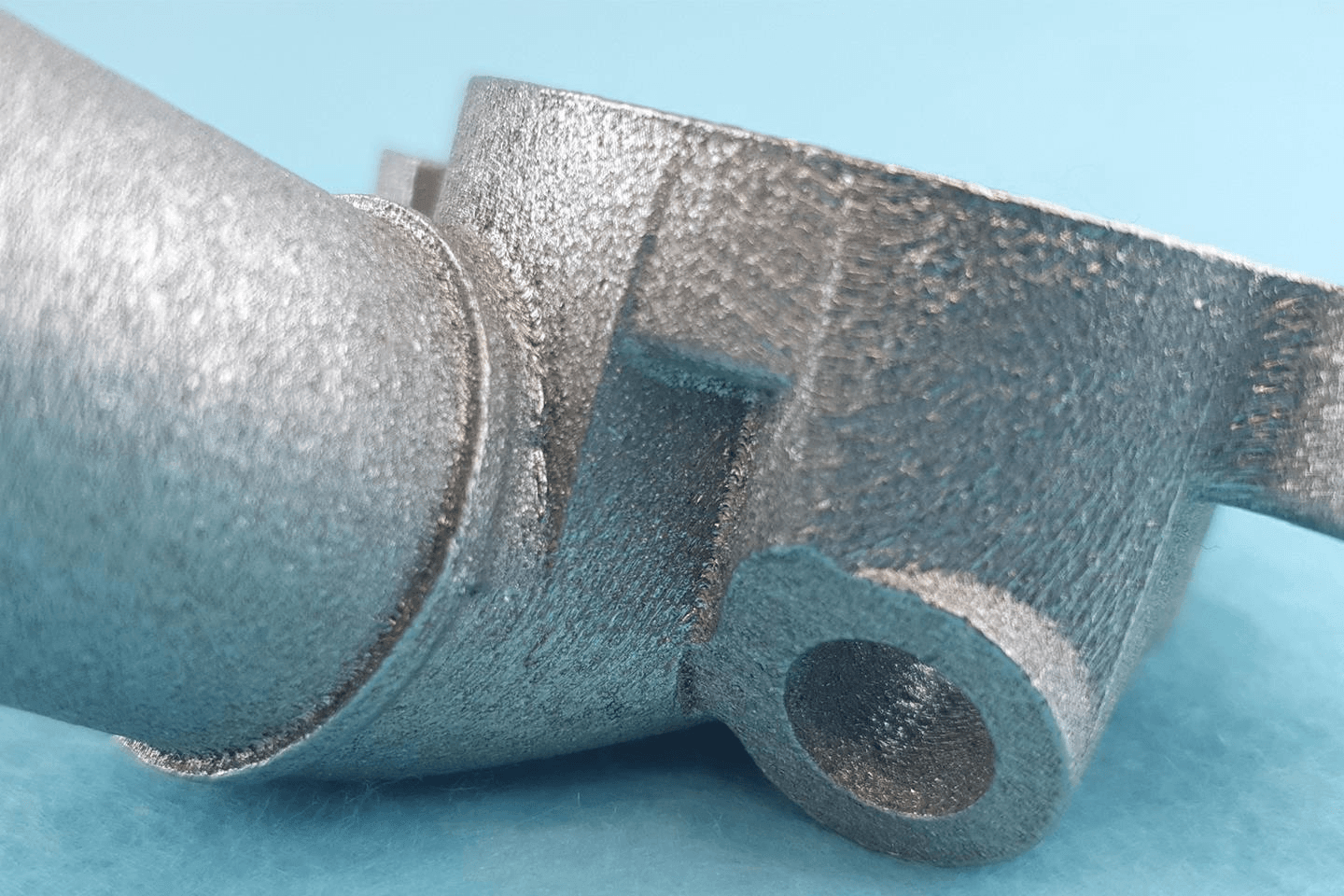
Metal 3D printing is worth considering when you need dense metal components for prototype manufacturing.As a natural side effect, raw printed surfaces often show powder balls and uneven bumps. You will usually need post polishing to hit your target tolerance and smooth finish. Equipment and printing costs run higher, so remember to budget for secondary finishing work when planning your prototype manufacturing project.
Standards reference: ISO explains that additive manufacturing standards cover 3D printing processes, materials and equipment, helping improve quality, safety and consistency. Buyers who compare suppliers or specify a production-intent process can review the ISO additive manufacturing standards overview for terminology and relevant standards.
Subtractive & Sheet Metal Fabrication
This group of prototype manufacturing methods covers solid stock machining and sheet metal forming. It fits nicely if you hope to test real base material performance at the sample stage.You can picture it as carving a solid block or bending thin metal sheets. We take a raw stock block and remove excess material to form the part. For sheet metal work, flat panels are folded to the shape you need.
CNC Machining
CNC machining uses digitally controlled cutting tools to strip extra material away from a solid blank, to form your target part for prototype manufacturing. This process is widely used for engineering plastic prototypes and precision components, especially when you need strict functional validation. Costs shift based on material waste, part complexity and total machining hours. The CNC programming plan also makes a big difference to final quality and tolerance. Undercuts and highly complex features usually push lead times and quotes higher.
Buyer note: Do not assume identical CAD files will bring identical CNC results. This is a common pitfall. The machine is just hardware , the program carries the actual manufacturing logic. Output can vary a lot between factories and individual engineers. A CNC program sets every movement path for the cutting tool. Even with the same drawing and the same machine, poor programming can leave heavy tool marks and create dimension drift or ruin the whole part.
Other Rapid Prototyping Processes
Next, I will introduce vacuum casting and rapid injection molding. While these do not fall under the category of typical additive or subtractive manufacturing processes.They serve as vital components in prototype validation and small batch preproduction workflows
Vacuum Casting
In vacuum casting, the “casting” process involves creating a silicone mold from a master mold and then pouring resin into the mold under vacuum to reproduce parts. It is important to note that the number of parts that can be produced via vacuum casting is limited It warps and creates bubble defects once you make too many copies. Check the table below for more on this prototype manufacturing method.
How to Choose the Right Rapid Prototyping Process
Drawing on years of hands-on prototype manufacturing work, here are six evaluation factors for purchasing teams: material, tolerance, surface quality, quantity, budget and lead time. Each scenario comes with recommended materials to simplify your prototype manufacturing decision
1 Material
As a buyer, you may select CNCmachined plastics like ABS, POM, PA66, alongside aluminum and stainless steel, for parts needing solid mechanical strength in functional and durability tests. Rapid injection molding runs standard production pellets such as ABS, PC and TPU.
Dimensional accuracy
As a buyer, turn to CNC engineering plastics, CNC metal, rapid injection molding and SLS when tight assembly and snap-fit checks matter in prototype manufacturing. PC, POM, PA and aluminum are go-to materials here. Go with SLA resin or rigid PU for simple assemblies with moderate precision needs. FDM PLA works for rough concept models where precision is less critical
External surface
As a buyer, choose SLA resin, vacuum-cast TPU or polishable CNC ABS/PC for display, coating and logo printing in prototype manufacturing. SLS nylon, FDM PETG and raw CNC metal fit functional builds without strict surface requirements.
Production Quantity
As a buyer, runs of one to five units fit 3D printing well. Go with SLA resin, SLS PA12 or CNC engineering plastics. Batches from ten to fifty parts suit vacuum casting, with flexible TPU or rigid PU resin options. For runs from 50 up to 1000 pieces, aluminum mold rapid injection works best in prototype manufacturing, using production-grade stock like ABS, PC and PP.
Delivery Cycle
As a buyer, 1–3 day rush jobs go to 3D printing with SLA resin or FDM PETG. 3–6 day timelines support single-piece CNC or vacuum casting with engineering plastics and PU resin. Rapid injection molding with aluminum molds works for 7–14 day schedules in prototype manufacturing, using production thermoplastics.
|
Requirement |
Good starting options |
Key buyer questions |
|
Material and strength |
CNC plastics or metal; rapid injection molding; SLS/MJF |
Does the material match the expected load, heat and chemical exposure? |
|
Dimensional accuracy |
CNC machining; metal CNC; rapid injection molding; SLS |
Which dimensions require inspection, and what tolerance is realistic? |
|
Surface appearance |
SLA resin; vacuum-cast PU/TPU; polished CNC ABS or PC |
Will the part be painted, coated, printed or used as a display model? |
|
Quantity: 1–5 |
SLA, FDM, SLS/MJF or CNC |
Is the part for concept review, assembly checking or functional testing? |
|
Quantity: 10–50 |
Vacuum casting or CNC |
How many silicone molds, setups or finishing operations are included? |
|
Quantity: 50–1,000 |
Rapid injection molding or a mixed process |
Does the tooling investment make sense for the total demand? |
|
Delivery: 1–3 days |
FDM, SLA or other available 3D printing |
Can the supplier confirm material availability and post-processing time? |
|
Delivery: 3–6 days |
Single-piece CNC or vacuum casting |
Are inspection and finishing included in the quoted lead time? |
|
Delivery: 7–14 days |
Rapid injection molding with aluminum tooling |
Does the schedule include tool design, trial shots and corrections? |
Conclusion
There is no single best rapid prototyping process for every project. We’ve run through these prototype manufacturing processes and selection pointers. You might still want custom guidance for your unique product. Send over your CAD files, specs, quantity and timeline to the Grashine team. We assess your project and put together a proper quotatio


Related Posts
Quality Assurance & Quality Control | Definition-Difference-Methods-Process
what is the injection molding-part1
Some tips help you understand electric injection molding machines